Sync in multiplayer mode
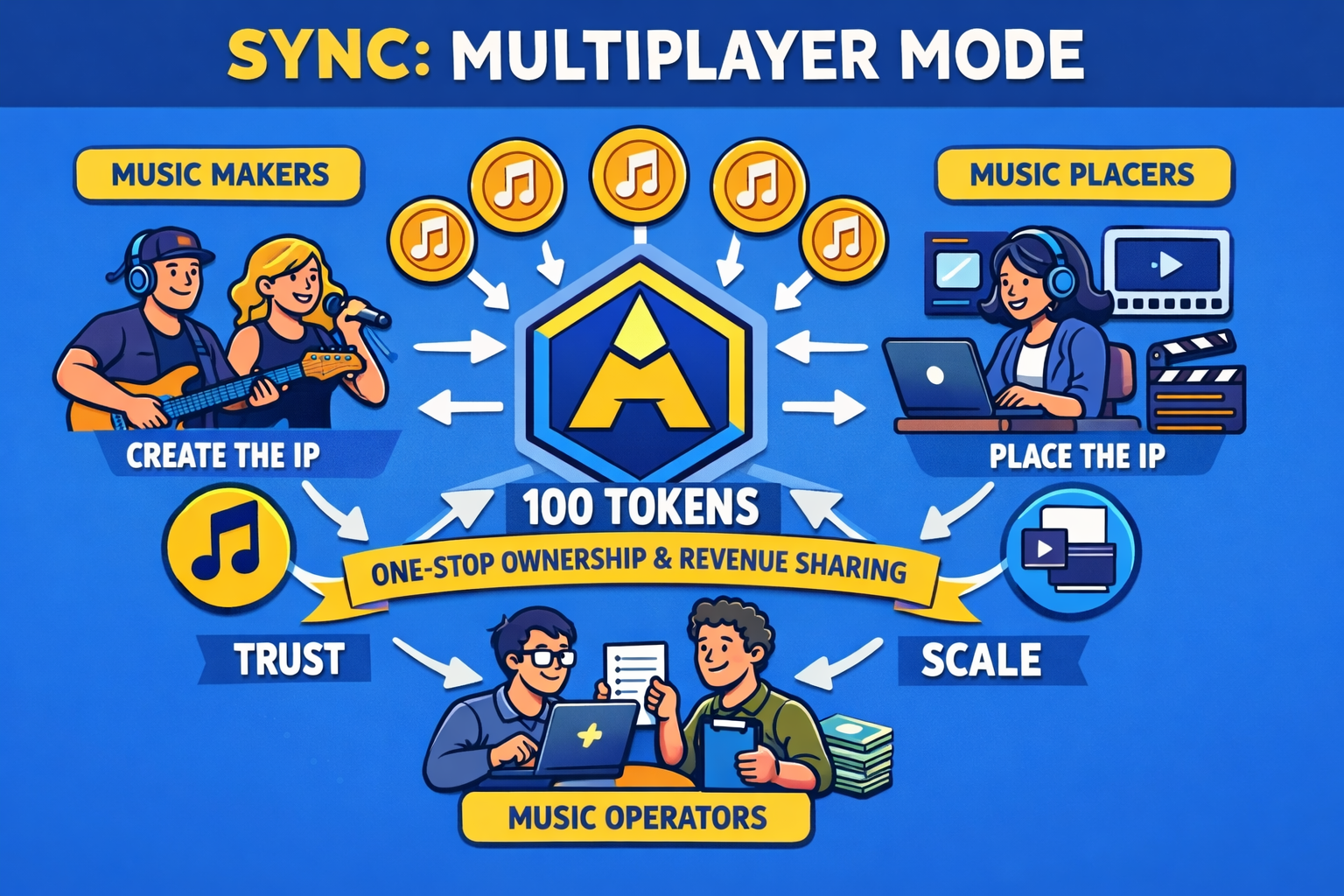
Sync licensing is a massive multiplayer game.
In the traditional sync business there are three key players: music makers (the people who create the IP), music placers (the people who source and clear music for shows/films/ads), and music operators (the publishers, labels, agencies, libraries, administrators, investors, and everyone else holding the system together).
At its best, this game looks like coordination: great taste, fast clearances, clean paperwork, fair deals, and a catalog that actually grows in long-term value for everyone involved.
At its worst, it looks like exploitation: fragmented ownership, legal confusion, opaque accounting, slow payments, and gate-keeping intermediaries competing for a small number of music placer budgets—while music makers are left reacting to the terms they’re offered.
Amerge exists because we think the “multiplayer” part is real… but the incentives are not yet aligned to reward cooperation.
If we can bring makers, placers, and operators onto the same team (with transparent participation in the long-term success of a catalog) then trust can scale with catalog growth, legal ignorance can be addressed before deals go sideways, and the entire system gets faster, safer, and more equitable. Creating more equity, more transparency, and more opportunity for all key players.
The players (and the problem)
If you’re reading this, you probably already know the basics: when a show, movie, ad, game, or other visual media uses music, they need a synchronization license. It’s a negotiation between the licensee (the one using the music) and the licensor (the owners/controllers of the music IP).
In practice, that negotiation is rarely “simple.” It’s often a maze.
Music placers (music supervisors, brand managers) need to find and clear the right song for the right moment: quickly, cleanly, and within budget.
Music makers (songwriters, producers) need to make a lot of the right music: music that’s useful enough to land placements.
Music operators (agencies, publishers, labels) sit in the middle, balancing budgets, timelines, and catalog value: while handling a portion of the administrative and clearance tasks.
So the question many generations of music makers have asked is still the right question:
“Why do we need that operator layer in the middle?”
In sync licensing, there are two main problems operators solve: trust and scale.
Problem #1: Trust
Trust is the big one.
A music placer isn’t only paid for taste. They get hired to find the right music for the right story, but their job largely depends on clean licensing: they need to know who owns what, who controls what, whether a track is “one-stop,” and whether there are any hidden landmines that could turn into lawsuits later.
This is especially hard because music rights are split into two sides:
Sound Recording (aka the “master”)
Composition (writing & publishing)
These are typically owned and controlled by different parties. Add multiple collaborators, multiple publishers, multiple labels/distributors, and suddenly one song can involve 10+ parties in the clearance chain.
Even well-intentioned creators can be unclear about what they actually control because the fine print in publishing deals, admin deals, distribution contracts, or catalog agreements can create carve-outs and exceptions that are invisible until it’s too late.
So placers often rely on what’s safe: a small circle of trusted suppliers, catalogs, and partners that are known entities. That’s how trust gets operationalized today.
Problem #2: Scale
Placers don’t just need one good song. They need a lot of good music, and fast.
Finding the right fit is often a process of elimination: you might not hear the perfect song until you’ve heard a dozen wrong ones. That takes time, and time is expensive.
Operators help scale this in two ways:
Catalog depth: thousands of tracks, organized and searchable, ready to pitch.
Transaction cost reduction: established processes, shared vocabulary, and clearance infrastructure that reduces the back-and-forth.
This can help music makers too. Intermediaries often provide access, relationships, pitching bandwidth, and administrative relief that an independent creator would otherwise spend years building on their own.
So the intermediaries do provide value, that’s why they exist. But, now the hard part: what is that intermediary layer worth?
Today, the market often answers that question in a way that creates a lopsided power dynamic. Operators can effectively set their take rate, and music makers (sometimes due to ignorance, sometimes due to desperation) accept terms that they would not accept in a more transparent system. As a result, the intermediaries take on average 50% of every sync deal. In a $3 billion sync market, that’s $1.5 billion currently locked in this middle layer!
The trust-and-scale trap
Here’s where the system breaks down:
Asymmetry of information: most operators don’t transparently report totals or terms.
Opaque accounting and payment flow: money can move slowly, with limited visibility.
Misaligned incentives: the people who do the work of making the music and the people who do the work of making money for the music aren’t always aligned on long-term value.
One common pattern:
A placement happens. The operator collects the full sync fee. Months later, the operator self-reports the deal terms, retains their agreed share, then pays one rightsholder. This rightsholder (sometimes the makers, but often another layer of intermediary like a label) now carries the burden of paying everyone else. Depending on the deal, other collaborators may not even be notified of the placement at all.
That’s an easy way to breed mistrust and conflict, even when no one is malicious.
And there’s another structural issue hiding in plain sight:
Music placers help create long-term value, but typically don’t participate in it.
When a sync placement creates a cultural flashpoint, the downstream impact can be massive. See Kate Bush and Stranger Things placement. Yet the people who made the creative decision, cleared the deal, and executed the opportunity usually don’t share in that long-term upside.
In short: the traditional system relies placers and operators to generate value, but it doesn’t structurally reward long-term cooperation across all roles. It’s a mess of competing interests and inefficient deal flows.
Amerge’s proposed solution: put everyone on the same team
What if everyone (from the makers to the placers to the operators) could be paid fairly and transparently for the success of a song?
What if the people who make the IP and the people who make the IP money shared in the same long-term outcome?
What if a single legal entity openly owned 100% of the IP of an entire catalog, truly one-stop, so licensing is faster, safer, and simpler?
That’s Amerge.
How it works: unified ownership + song tokens
In Amerge, complete ownership of each work in the catalog is assigned to Amerge Music Co-op. Both the sound recording and composition copyrights.
For each work, Amerge generates a corresponding set of 100 unique tokens. These 100 tokens represent all future revenue of that work. Amerge distributes the tokens to the people who do the work of creating the song, and those who create value for the song. The tokens are a new liquid asset. One that has never existed in the music industry until now.
Whether a single $1 comes in from Spotify royalties, or $250,000 comes in from an Apple ad; all revenue from all sources is sent directly to the current token holders. If you hold a token, you hold a share of revenue.
Because Amerge owns both the sound recording (master) and the composition (publishing/writers), it’s not just a portion of revenue. Not just the publishing revenue. Not just master share. The tokens represent all sides. All value. Forever.
By concentrating the entire value flow of a work into a single set of 100 tokens, we align every token holder to contribute to the success of that work: creatively, operationally, and commercially.
No more division of composition vs. sound recording.
No more division of admin vs. creative.
No more division of makers vs. placers vs. operators.
Every token holder is aligned. Moving in lock-step to increase the long-term value of that work.
A simple example
Let’s say you’re a music placer and you receive 10 of the 100 tokens for “Song A” in exchange for pitching it and bringing it into your network.
A few months later:
“Song A” lands a $5,000 sync on a network TV show (sound recording + composition).
You hold 10% → you receive $500
Then, thanks to the visibility of the show, “Song A” goes viral and generates $1,000 in streaming royalties (sound recording).
You hold 10% → you receive $100
Then, let’s say you hired a coordinator and gave them 3 of your 10 “Song A” tokens as an incentive to create new opportunities for the song. The coordinator gets a major artist to cover the song and the cover generates $10,000 in mechanical royalties (publisher/writer).
You hold 7% → you receive $700
Coordinator holds 3% → they receive $300
Now imagine this at scale across hundreds of songs with hundreds of people working to generate value in the collective Amerge catalog. Every dollar coming in and every dollar going out of the network transparently visible to all network members.
Scale at the speed of Trust
The two biggest problems of trust and scale are solved with this new model. Amerge unifies the three key players (makers, placers and operators) into the same multiplayer team.
Trust is greater in the Amerge system because ownership and revenue are more legible. No more confusing webs of publishers, labels, and agencies. Each work is brought under unified, one-stop control through the Amerge cooperative. IP ownership stays with Amerge and revenue ownership is owned by token holders. Each work’s revenue is represented as a single set of 100 tokens that cover 100% of the work’s value flow: composition and sound recording combined. That means every stakeholder can see, in simple terms, who owns what and what they’re owed. No more hidden splits or last-minute clearance surprises. The music placer’s risk drops dramatically, music makers don’t have to chase down money, and deals flow faster.
The problem of scale is addressed by turning the old system of siloed workers and competing interests into a cooperative infrastructure where all parties share in the long term success of the value they create. Instead of rebuilding clearance logic, split logic, and payment logic for every new song (and every new collaborator), Amerge standardizes the unit of work. When a song enters the system, tokens reflect the split, and revenue can flow directly to token holders without the need for a team of accountants, lawyers, or admins to send and explain royalty payments. This makes it easier to expand catalog volume without expanding administrative chaos. As the catalog grows, the system doesn’t get messier; it gets more searchable, more licensable, and more reliable, because the same rules apply to every work. Scale is no longer dependent on intermediary bandwidth. Amerge unlocks new growth with aligned incentives and fully transparent value flow.
We create more trust by bringing all players onto the same team as co-owners in a cooperative system. Amerge scales at the speed of this trust through song tokens – transparently sharing all future value of each work.
The real innovation: liquidity & transparency.
Production companies, studios, and supervisors have been finding ways to share in the backend value of catalogs for decades. But these opaque backroom deals create a hotbed for bad actors and obscenely high take rates. Not to mention being extremely complicated to collect and distribute royalties from a thick layer of intermediaries along the way.
Amerge’s innovation is the liquidity and transparency of revenue via tokens. It’s a subtle shift that unlocks a multiplayer mode that is far harder to achieve with bespoke entities and five-page contracts for every edge case.
It’s coordination infrastructure. A way to share and receive long-term value cleanly, transparently, and in proportion to contribution across all roles that make sync licensing possible.
By concentrating all future value into a set of tokens for each work we unlock a new multiplayer level of the sync game that has never been played before. We can use the tokens of each work as a new liquid asset to receive but also give value. The new opportunities this creates are endless but here are a few examples:
Funding the creation of new music by preselling song tokens to investors
Incentivizing the usage and placement of music by sharing tokens with content creators and media organizations
Compensating collaborators by sharing tokens with musicians, studio owners, and other creative professionals who help create the music
Pooling collections of high value song tokens into a cashflow back fund to pay for things like equipment, health insurance, or retirement accounts
Public dashboards showing the most high value songs in a catalog
The future will Amerge
Amerge is the world’s first onchain music licensing cooperative. We’re fixing the sync industry’s two problems (trust and scale) by aligning music makers, music placers, and music operators onto the same multiplayer team: transparently sharing in the long-term value of a catalog. In the legacy system, fragmented ownership across composition and master rights creates clearance risk, slow payments, opaque reporting, and a middle layer that traps $1.5 billion in annual take rates. Amerge brings each work under unified, one-stop ownership represented by a set of 100 tokens that cover 100% of the work’s value flow (composition + sound recording), with all revenue flowing directly to token holders. This makes ownership and revenue legible, reduces placer risk, and standardizes splits and payments so the catalog can scale without expanding administrative mess. Together we are building a new era of consistent rules, aligned incentives, and fully transparent value flow. If you want to participate in transforming the sync industry, please consider joining the co-op and contributing to our growing network of makers, placers and operators!